-
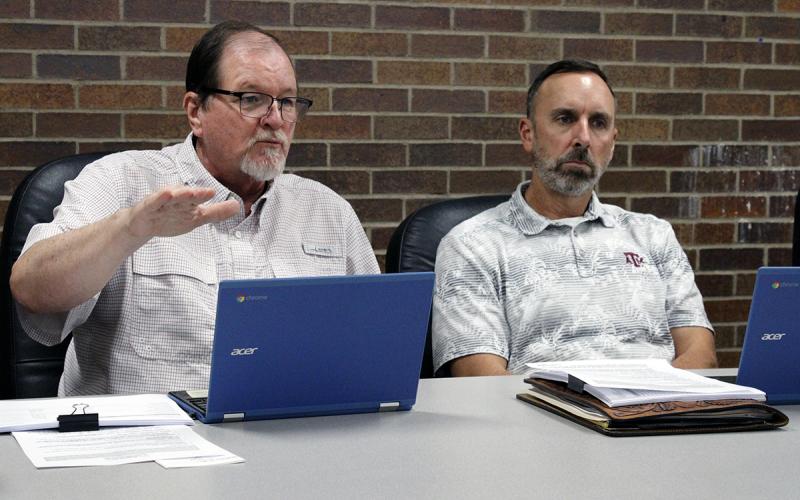 Jacksboro Mayor Pro Tem Joel Hood (left) said the city didn’t have much option other than to increase the tax rate to sustain the budget through the next fiscal year. Council adopted the proposed budget and tax rate increase Monday, Sept. 8. Photo/Ashley Anderson
 -
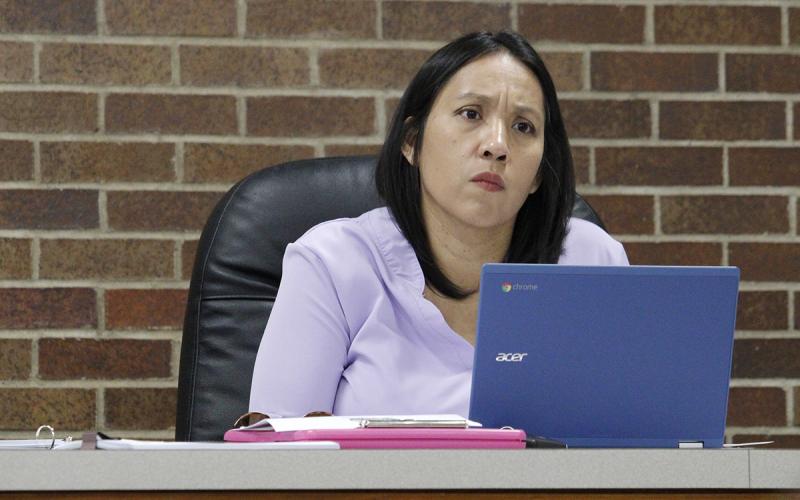 Jacksboro City Council member Libby Gonzales asks if the tax rate increase will sustain the proposed budget. The council adopted the budget and tax rate increase Monday, Sept. 8 at City Hall. Photo/Ashley Anderson
City of Jacksboro adopted the proposed budget and a tax rate increase of $0.710000 per $100 valuation for fiscal year 2025-2026 following a public hearing Monday, Sept. 8, adding approximately $23.67 (1.945%) more to the annual tax bill for the average homeowner.
City council voted on a proposed rate of $0.695901 in August as city officials continued to work to balance the proposed budget. City Manager Mike Smith said even after making cuts to the budget, the city still came up about $25,000 short.
“That’s about the only way—that I could find—that we could get a balanced budget,” Smith said.
Smith said increasing the tax rate would balance the general fund, and to balance the water fund, or Fund 20, he suggested the city implement a three-cent increase to water rates and increase the capital improvement fee by $3.
“I also think, on the water side, this puts us one step further because when we do start building the water treatment plant, we’ll probably have to adjust our rates then as well,” Smith said. “So it won’t be such a huge increase.”
Smith said budgeting for the water fund was difficult because the city was paying interest on $2 million in engineering fees for the water treatment plant project until grant funding kicked in for payments.
“That more than doubled our debt service for the water side for this year,” Smith said. “Last year we were at just a little over $200,000 in debt for Fund 20, but we’ve got to pay some interest on that $2 million we borrowed so that took us up well over $400,000—just for debt this coming year for Fund 20.”
Council members weren’t eager to increase the tax rate but understood the city still had to provide services to the community like police, fire and water utilities.
“We’re caught in the middle of a rock and a hard place. We’re talking about a community we love, care about and feel responsible for, and we have to provide certain services,” Mayor Pro Tem Joel Hood said.
Hood said because the city didn’t have a strong revenue source there weren’t a lot of options other than raising the tax rate. Until something changed, he said, they’d have to find a way to make it work.
“We’re not seeing them move at the same rate—the amount of growth and industrialization that would increase our tax base are not progressing at the same rate of the cost of the services we provide,” Hood said. “If that means raising taxes a little bit, if we’re doing it responsibly…after looking at this budget I don’t see anywhere that we are not being expedient in the way we’re spending the money we do have.”
With “no bells and whistles” in the budget, Smith was at a loss as to what else to cut.
“We really only have two options. We reduce services or we get more sales tax coming in,” Smith said. “I feel confident as time goes by we’ll get more houses, we’ll get more businesses. But how long is all that going to take?”
Council has historically adopted a no new revenue rate, and while the adopted rate was higher than the no new revenue rate at $0.698844, it was lower than the voter approval rate at $0.750965.
Smith said he was confident the increased tax rate would sustain the budget through the next fiscal year.
“I just think we’re in a position right now that we need to set ourselves up for next year and not put ourselves in a deeper hole,” Smith said.
The budget and tax rate increase were both adopted unanimously by record vote.
- Log in to post comments